

Burned
The health effects from global warming begin
One morning last week I saw these headlines cross a TV screen: heat waves across the U.S., wildfire smoke blanketing the Midwest and Northeast, and flash flooding in Texas and New Mexico. It hit me that, after years of warnings, the human damage from global warming has now started.
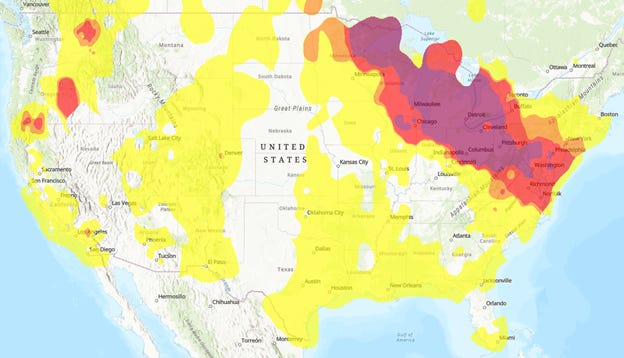
And that made me wonder how big that toll is today, and how big it might become.
Climate change…
During the 2020 presidential election, nearly every Democratic candidate described climate change as an “existential threat”. In the Trump era, though, the topic has all but disappeared from our national conversation, pushed aside by the threat to our democracy and by political consultants telling Democrats to shut up about it.
But as environmental activist Bill McKibbin points out, “physics is running the show, and it won’t be long denied.” In 2024, global temperatures were 1.2 degrees Celsius above the 20th century average, and the rise is accelerating.
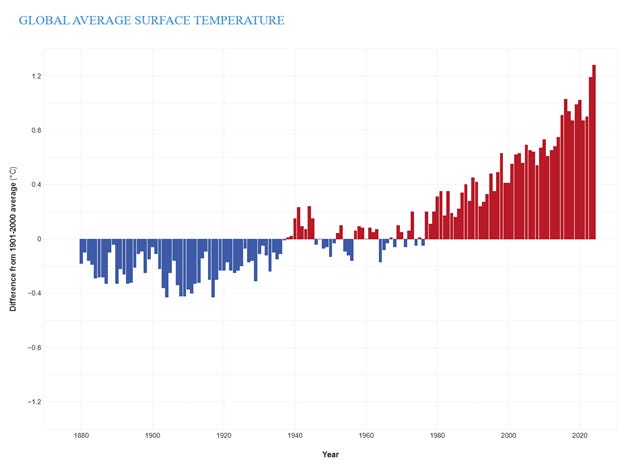
That average temperature increase comes with more frequent heat waves and other extreme weather events like droughts and sudden torrential downpours. And of course, melting polar ice caps leading to rising sea levels.
…and health
The World Health Organization has called climate change “the single biggest health threat facing humanity”. Those are strong words.
So far, though, the WHO doesn’t have the numbers to back them up. In 2014, a group of experts convened by WHO estimated that between 2030 and 2050, climate change would lead to about 240,000 additional human lives lost annually. When I read their report, I thought: that’s all?
I don’t mean to be callous. A quarter million people dying unnecessarily is an enormous human tragedy. But it’s a relatively small number in a world of 8 billion people, in which 7 million adults die from tobacco use and 2.6 million mothers and children die from malnutrition each year.
There’s no question that climate change will be devastating to other species. It may cause as many as one in 12 to go extinct. But humans are the planet’s most adaptable species, who inhabit settings as harsh as Antarctica and the Sahara desert. Based on what we are seeing now, WHO’s comment sounds like the kind that overstatement that undermines the credibility of people arguing for climate action.
But as I looked into this, I realized that predicting what global warming will do in 20 or 30 years is a fool’s game. Here’s what we know now:
Heat
With global warming, we are having more heat waves, and heat waves are lasting longer:
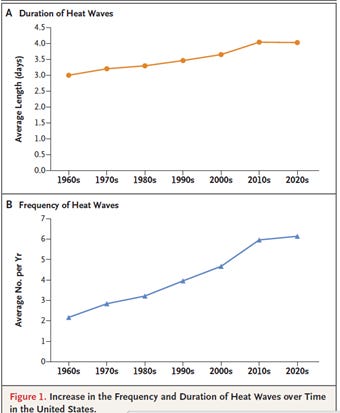
Extreme heat increases the number of people who die from heart, lung, and kidney disease. Heat waves are also bad for pregnant women, increasing the risk of preterm birth and stillbirths, and they stoke mental health problems, from depression to aggressive behavior. Best estimates are that heat waves cause 1,000 – 2,500 extra deaths a year in the U.S., of which maybe a third can be attributed to human-induced climate warming.
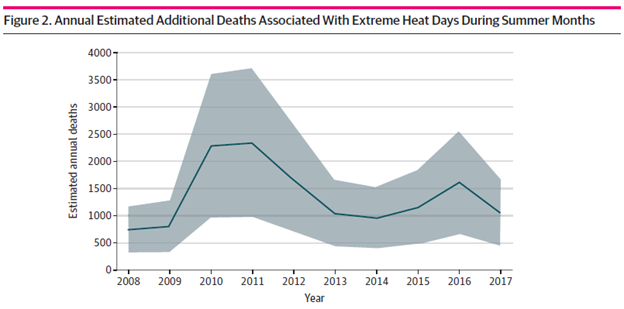
Worldwide, the WHO experts estimated that between 2030 and 2050 the number of deaths from excess heat would rise from 40,000 to 90,000 a year.
Drought
Heat and changing weather patterns are increasingly causing droughts across the world, affecting about 10% of global land area.
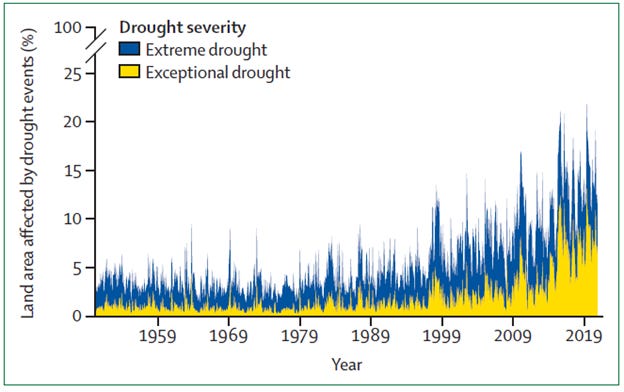
Drought means that farmers produce less food. That likely won’t affect people like you and me, but it will cause malnutrition in people who survive on the crops they grow, particularly in sub-Saharan Africa. The WHO experts estimated that falling crop yields would cause 95,000 additional deaths a year from malnutrition.
Floods
A warming planet means that more water evaporates from the ocean, the atmosphere holds more water, and rainstorms become more intense, all of which creates flash floods. Floods can kill people suddenly (and terrifyingly) – as they did in Texas’ Camp Mystic last year - or the floodwaters can have lingering indirect effects by damaging infrastructure and upsetting ecosystems. One review found a 26% increase in mortality in the few months after floods.
I couldn’t find estimates of the number of total deaths caused by flooding in the U.S. or worldwide, but because floods tend to affect limited areas, the total number of deaths is probably not large. (That is no comfort if one of those is your child, though.)
Air pollution
I’ve long thought that air pollution doesn’t get enough attention as a health risk, maybe because pollution levels are much lower in the U.S. today than in the past. The fine particles and gases in air pollution, when breathed in every day for years, cause damage not just to the lungs but also to many other organ systems. Today, air pollution is thought to be responsible for 80,000 deaths a year in the U.S. and nearly 8 million worldwide, making it a leading killer globally.
The main sources of fine-particle air pollution in the past in the U.S. have been coal-fired power plants and vehicles that burn gasoline and diesel fuel. But in the past 20 years, the combination of drought and heat has set forests on fire, and the smoke from these fires (that dull haze that many of us saw last week) is becoming an increasingly large contributor to air pollution.
With global warming, wildfires are likely to get much more common. Here are recent models of wildfire smoke emissions from the western U.S. under different climate change scenarios. Looking at these maps makes me wonder if we’ll ever see a clear summer day or there will be any trees left in the West by 2060.
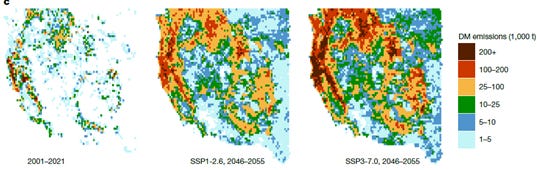
The brunt of the smoke will be felt by people in western states. But as we saw last week, wildfire smoke drifts across entire continents, so the largest number of smoke-related deaths will happen in the densely-populated states of the Midwest and Northeast.
In these models, some 41,000 people in the U.S. die per year from the effects of wildfire smoke today, rising to 75,000 by 2050. That’s orders of magnitude higher than the deaths from the heat itself.
Infectious diseases
It’s easy to imagine how, by disrupting ecosystems, climate change might expose humans to many different infectious diseases, both old and newly discovered. Changing temperature and humidity will allow some micro-organisms and the species that they depend on to thrive and find new hosts to infect.
The biggest single worry today is malaria, the parasite for which needs warm temperatures to spread. Malaria already sickens 280 million people and kills about 600,000 a year worldwide. When cooler areas warm up, the WHO guesses that malaria deaths will increase by another 60,000 per year. It’s possible that malaria could start spreading in the U.S.
With increased temperatures and water shortages from drought, people have less clean water for drinking and washing, which allows diarrheal diseases to spread. That’s not likely to be much of a problem in the U.S., but the WHO estimates that it might cause an additional 48,000 deaths per year in the poorest countries of the world.
Overall, though, infectious diseases are the joker in the deck. When a new virus like SARS-CoV-2 with only 10 genes can cause 15 million deaths worldwide, it’s clear that small changes in infectious agents or environments caused by climate change can have massive human health effects.
The future
So as I look at it, in the next 10 years or so, the human toll from climate change is likely to be substantial, but not catastrophic.
But after that, who knows? We’re just beginning to see the health effects of today’s temperatures, and under different scenarios, global temperatures could rise another one to two degrees Celsius. That will radically shock the ecology of the planet. It is impossible to predict the combined and domino effects of multiple ecosystem changes.
The example of wildfire smoke makes the point: heat + drought => wildfires => air pollution => heart and lung disease. Today that chain of events is obvious, and it’s the effect that is killing the most humans by far. In 2014, though, the WHO experts didn’t even mention it.
The diseases that ultimately kill the most humans from global warming are probably ones that we aren’t even thinking about today. And I’m not placing any bets on how many will die.
I'm curious- did you have a similar reaction to Hurricaine Katrina? I remember conversations about worsening natural disasters at that time, too.
It's frustrating to think that we could've paid attention much, much sooner.