

Why Did Let's Move Fail?
Lessons from Michelle Obama’s childhood obesity initiative for MAHA
In February of 2010, Michelle Obama stood in front of a packed room and launched Let’s Move, her initiative to end childhood obesity in a generation.

Specifically, the goal of Let’s Move was to cut the percent of children who were obese from 17% in 2007-08 to less than 5% by 2030.
How well did it work? The results are in, with data published by CDC last week, and they’re ugly. Instead of falling, childhood obesity rates have surged to their highest ever. By 2021-23, more than 21% of American children were obese, including 7% classified as severely obese.
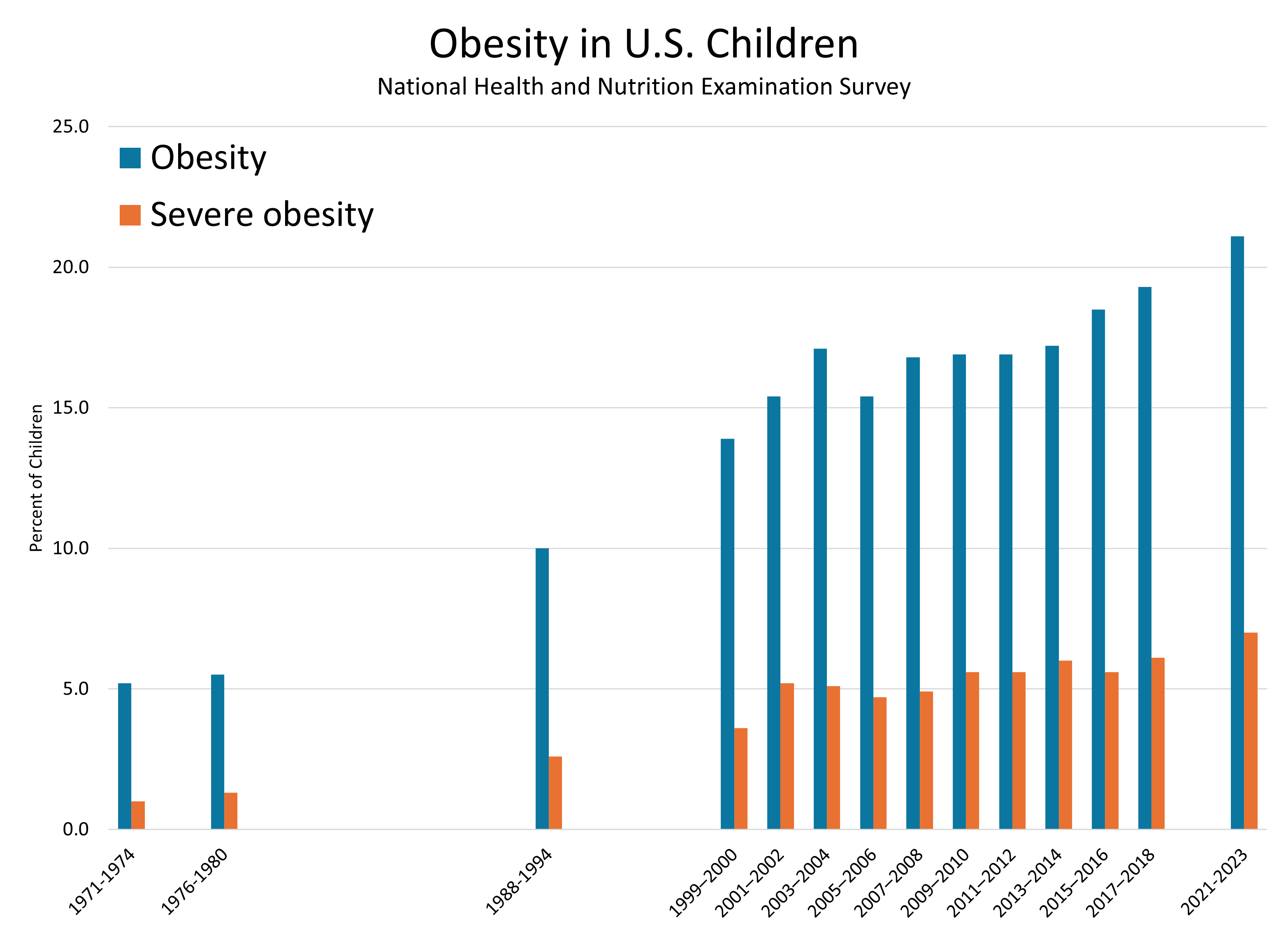
So Let’s Move failed, despite having a lot going for it, including broad-based public and private support, enthusiasm from health experts, a Congressional request for $10 billion, and political oomph that comes from the White House. It’s high time to own up to that failure and to conduct a post-mortem – not just to learn but also to guide the MAHA crowd that hopes to take on ultra-processed food today.
What did Let’s Move promise?
Keeping the tradition of First Lady initiatives, Let’s Move was a big tent, feel-good project. At the launch, it seemed that every major player was on board, including the USDA, health advocacy groups, education groups, big-money health foundations, and “leaders from the media, medical, sports, entertainment, and business communities who impact the health of children and want to be part of the solution.” The media giants – Disney, NBC Universal, and Viacom – signed on, as did the three big companies that sell school food. Even the soda companies, through the American Beverage Association, promised to put calorie counts on their bottles. To prop up the big tent, Michelle Obama created a new nonprofit organization, the Partnership for a Healthier America.
At the launch and in a National Action Plan released a few months later, Obama proposed to:
Make school food healthier,
Get packaged food companies to adopt “nutritionally sound and consumer friendly” labels on the front of food packages so that parents could make better grocery choices,
Revise the confusing food pyramid (into what became MyPlate),
Eliminate “food deserts”,
Reduce the marketing of unhealthy food to children,
And dozens of other voluntary and smaller initiatives, like getting professional sports leagues to encourage kids to be physically active.
WIC offered a head start
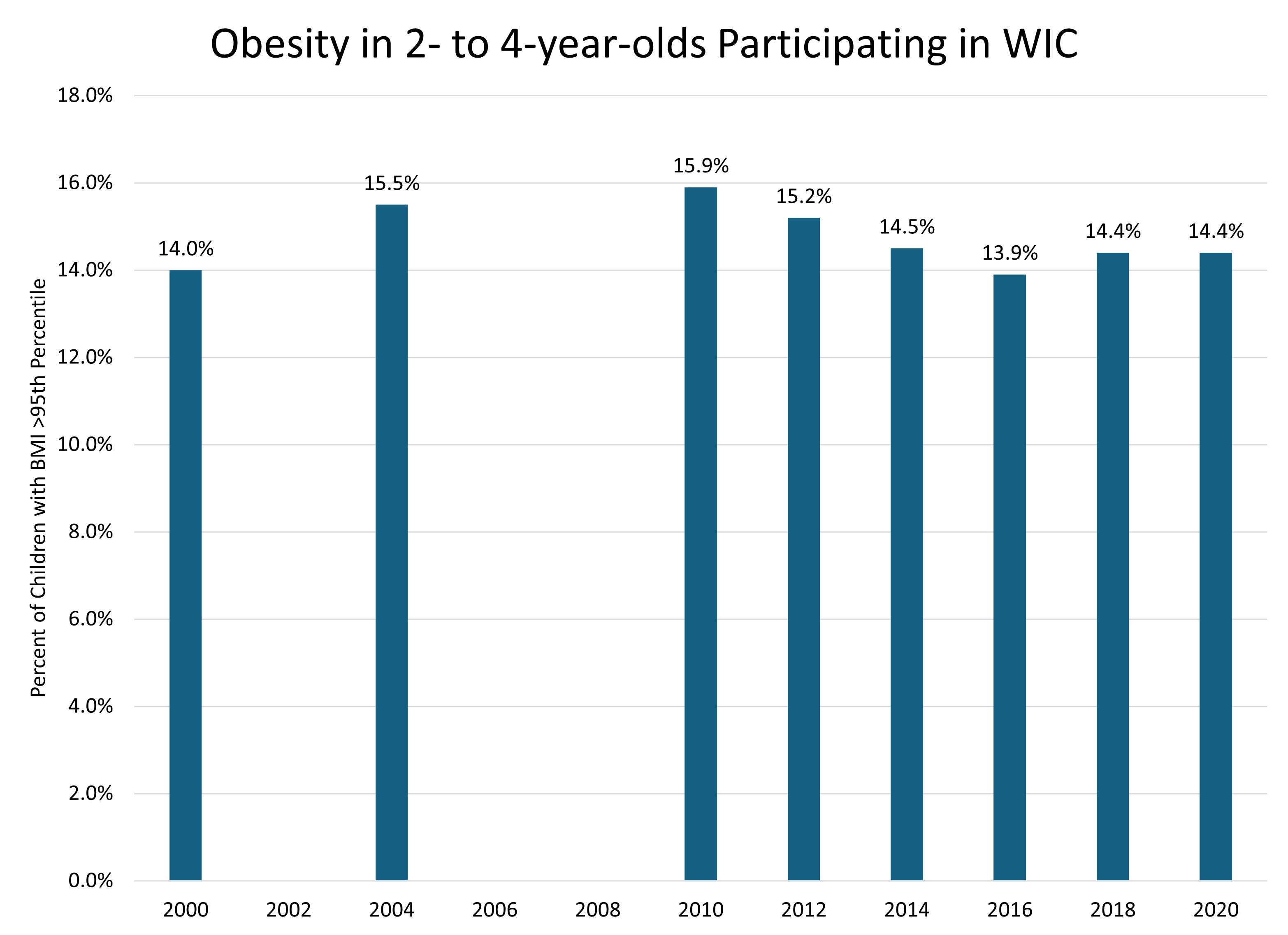
Obama got a boost even before she launched Let’s Move. In 2009, the USDA updated the rules of the Special Supplemental Nutrition Program for Women, Infants and Children, known as WIC. This program gives vouchers to low-income mothers to buy a very restricted group of food items. That year, the USDA improved the WIC food package, increasing the amount of fruit and vegetables, requiring whole grains and low-fat milk, and including less juice and cheese.
The change worked just as health experts had hoped, with children on WIC eating a healthier mix of foods and families purchasing 11% fewer calories. Nationwide, obesity rates in WIC-participating children, which had been steadily increasing, reversed course. Only about 25% of American kids in this age group were on WIC, but it was a promising start.
What did Let’s Move do to school food?
Let’s Move’s signature policy was the Healthy, Hunger-Free Kids Act (HHFKA). This law made more children eligible for free school meals and then required healthier food in those meals. The new food standards, put out by the USDA in 2012: increased fruits and vegetables; replaced refined grains with whole grains; replaced whole milk with fat-free or low-fat milk and prohibited sweetened chocolate milk; and limited the sodium, fat, and calories in meals. The law also established nutrition standards for “competitive foods” – that is, foods sold in school cafeterias outside of the federal program.
Food industry pushback began even before the USDA published its rules. The National Potato Council and a legislator from Maine forced the agency to drop limits on starchy vegetables. A major producer of pizza and its legislator from Minnesota demanded that the tomato sauce on a pizza count as a vegetable.
Then the regulations came under fire by the School Nutrition Association, an organization of school food providers with close ties to food manufacturers. The SNA complained that the regulations were too expensive, that they couldn’t find products that met the nutrition standards, that children wouldn’t eat healthy food, and that food was increasingly go to waste. Studies disproved all these complaints, but Congress backpedaled anyway, delaying the move to 100% whole grains and the sodium limits in annual appropriations bills.
By 2017, Trump had replaced Obama in the White House and his appointees further weakened the food standards. In 2019, sweetened chocolate milk was back, only 50% of grains needed to be whole grains, and the sodium limits were delayed again. As of 2025, under Trump 2, full-fat whole milk is now back, too.
Despite this partial unraveling, studies suggest the healthier school foods may have reduced obesity in schoolchildren a bit. Only by a bit, though.
And the rest of Let’s Move…?
The HHFKA ended up being the only enforceable policy in Let’s Move. All the rest proved to be promises that were half-fulfilled or that disappeared under the cover of the opioid crisis and COVID-19.
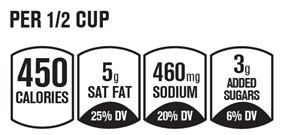
The promise of “nutritionally sound and consumer friendly” information on packaged food ended up as the industry-created, voluntary Facts Up Front labels. These labels are a jumble of numbers and letters that almost no one can interpret:
At the tail end of the Biden years, the FDA proposed a mandatory front-of-package label that was slightly better, but it’s likely to go nowhere in Trump’s FDA.
The promise to reduce marketing of junk food to kids became weak voluntary guidelines that the food companies often ignore. Children still see more than 1,000 food-related ads a year on television alone.
My Plate has now been replaced by Kennedy’s meat-heavy food pyramid.
Food deserts – or, better put, neighborhoods where unhealthy food sources greatly exceed healthy food sources – have become more common, not less.
The Partnership for a Healthy America still exists, but it has given up on fighting obesity, instead shifting to increasing access to fruits and vegetables. Among other work, this weakened organization offers healthy meal boxes that sound a lot like MAHA food boxes.
What happened to child obesity?
In the early years of Let’s Move, I was among many in public health who were excited that it might actually be working.
It didn’t pan out, though. Recently, epidemiologists compiled data from many sources into a model that shows the trends in obesity in more detail. In their model, it does look like the sharp rise in obesity since 1990 became slightly less steep around 2010.
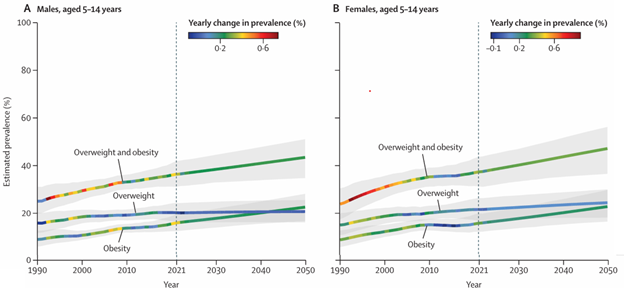
The Let’s Move folks might argue that without their efforts, childhood obesity today would be even worse. It’s hard to take comfort in that.
Why did Let’s Move fail?
So why, despite the best of intentions, did Let’s Move fail?
First, it relied far too much on “partnerships” with companies whose core business is selling obesity-causing food. Those feel-good industry relationships just enabled companies to weaken regulations and drag their feet until the political winds changed.
Second, it shied away from regulation. The partial success of the revised WIC and the school food rules show that regulations work. But the prevailing tone of Let’s Move was cooperation instead of requirements.
Third, Let’s Move strayed into the view that the obesity epidemic is caused by a lack of access to healthy food. It isn’t. The epidemic is driven by the over-abundance and heavy-duty marketing of unhealthy food.
Fourth, it chose its target to be obesity in children. Obesity is a problem for everyone. Most people gain most of their weight as adults. By narrowing its focus to kids, Let’s Move painted itself into the corner of school food, ignoring the rest of the food world.
These strategic mistakes meant that Let’s Move didn’t, for example, produce a national sugar-sweetened beverage tax, front-of-package warning signs, a prohibition on adverting junk food, or hard-hitting counter-advertising a la Tips from Former Smokers. Taking lessons from the successful anti-smoking movement, those are policies that might have worked.
Kennedy’s MAHA moms include well-meaning people who just want to prevent their kids from becoming fat and sick. I hope some of those MAHA moms will take the Let’s Move failure to heart and push for rules that can actually do that.
This actually reminds me of Jamaica Moves.
Jamaica launched that initiative in 2017 to tackle non-communicable diseases like diabetes and heart disease. The focus wasn’t just childhood obesity, it was getting the whole population to move more, eat better, and check their numbers (blood pressure, blood sugar, BMI).
One interesting difference: Let’s Move centered a lot on kids and school food, while Jamaica Moves is more community-wide. It included workplace challenges, public walks, national awareness campaigns.
But there’s also a similarity. Both leaned heavily on encouraging behavior change; healthier choices, more activity rather than completely reshaping the food environment itself.
It’s interesting to compare them because it shows how hard this issue is. Awareness campaigns matter, but changing national health trends is a long game.
There is so much more going into obesity than food and exercise. It’s a symptom of lack of supports for families in our country. Yes, we need to work on food deserts. We need more gym/recess time in schools, better school breakfasts/lunches.. and we need to bring actual kitchens and cooking back into our schools. But the obesity epidemic isn’t because of a lack of knowing which foods to eat or lack of caring. It’s lack of access. And yes, I mean for people in food deserts but also in terms of time.
Parents are struggling to do it all. Both parents are working at least one job each (oftentimes more than one job each) and playing taxi cab during any off hours. Many times with only one family car and no public transportation. They don’t have time to meal plan, shop, cook, exercise (and many don’t have the money, living paycheck to paycheck, worrying that their next illness will mean bankruptcy). They don’t have a village to help them either. Grandparents live far away and neighbors don’t support each other like this in our culture.
For years, our society has told people to “find the time” to exercise and eat right instead of recognizing that time is a privilege for only a few. Time and money are the barriers to a healthy America and what needs to be addressed. Families are in constant survival mode in the US. When we start supporting our families: minimum wage equaling a living wage (families used to survive on *one* income), universal healthcare, affordable high quality childcare, affordable housing, affordable college, paid parental/sick leave etc etc etc we will see obesity rates improve. Billionaires get tax cuts and monopolies, the DOD contractors get war, and families get nothing.
People want to eat well and exercise, but they need to get out of survival mode first.